The Mind Body Effect by Herbert Benson
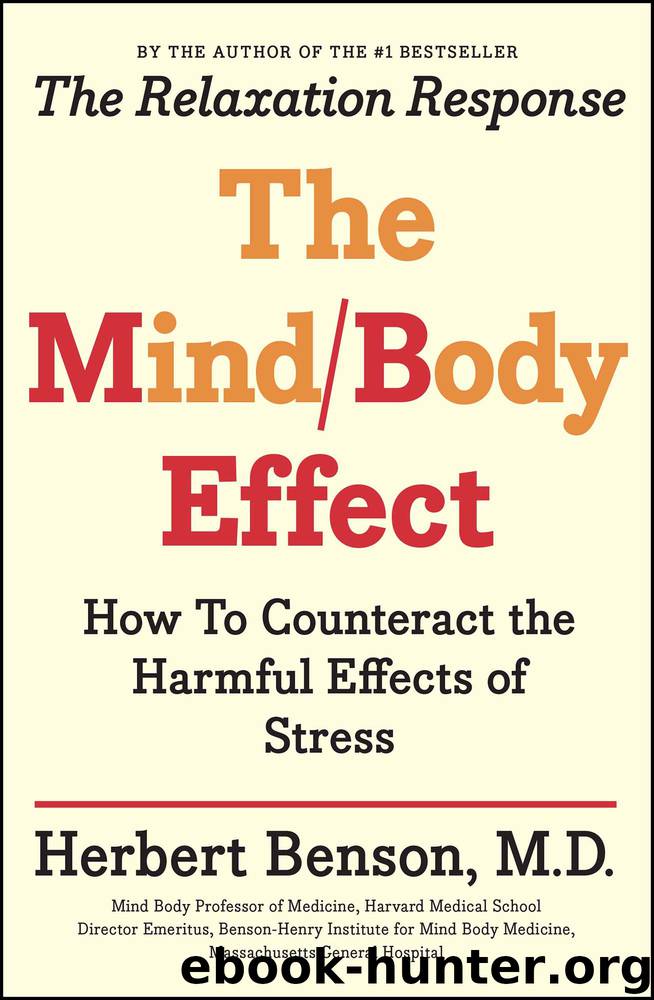
Author:Herbert Benson
Language: eng
Format: epub
Publisher: Simon & Schuster
Published: 2019-07-01T16:00:00+00:00
IATROGENESIS
Iatrogenic, from the Greek words iatros (physician) and gennan (to produce), may be defined as resulting from the actions of physicians. Originally the term referred to disorders induced in the patient as a result of the physician’s examination, manner or discussion. That is, iatrogenic ailments were those precipitated by a physician who was not sufficiently aware of his patient’s anxiety or of the effects of his words and actions upon the patient. The word iatrogenic is now applied to any adverse condition or illness which is engendered by the physician. Indeed, for centuries the physician’s power to harm has been recognized. Latham was aware of this potential when he said: “Among the perils of disease we must not refuse to reckon the errors of physicians.”
The frequency of iatrogenic disease in modern medicine is substantially increasing. The number of drugs and procedures, both diagnostic and therapeutic, utilized by the medical profession has increased substantially. As has been discussed, this proliferation has had many magnificent consequences. Millions of lives have been saved or prolonged, and those with incurable diseases have been made much more comfortable. We can no longer state, as did Dr. Oliver Wendell Holmes, the physician and man of letters, in 1860: “Throw out opium… throw out a few specifics which our art did not discover… throw out wine… I firmly believe that if the whole materia medica, as now used, could be sunk to the bottom of the sea it would be all the better for mankind,—and all the worse for the fishes.” Unfortunately, the recent contributions of medicine have been coupled with great increases in the number of adverse complications directly attributable to drugs and diagnostic and therapeutic procedures. The potent drugs and effective equipment used today possess a far greater potentiality to harm. The iatrogenic reactions, as noted by Dr. J. F. Gwynne of the University of Otago in New Zealand, “[vary] in severity from the trivial and transient to the irreversible and fatal.” Discretion must be exercised in drug usage to avoid possible dangers.
Whereas historically the surgeon was largely responsible for the majority of the iatrogenic complications, the medical doctor prescribing drugs has recently become the main perpetrator of iatrogenic death and disease. Today the most common iatrogenic occurrences are those resulting from the use of drugs. We are in the midst of a “pharmacologic revolution,” a “chemical age,” or a state of affairs called “polypharmacy.” In the 1978 Physicians’ Desk Reference (PDR), the most commonly used source of drug information, there are over 1200 different generic drugs listed. There are over 5000 brand names by which these generic drugs are marketed.
Iatrogenic reactions leading to death, especially those related to drugs, have reached alarming proportions. In a report published in 1975, Dr. Nelson S. Irey of the Armed Forces Institute of Pathology estimated that between 6000 and 12,000 deaths occur annually in the United States from adverse drug reactions. The tragedy of this situation is that many of these deaths are unnecessary, since we are overusing drugs.
Download
This site does not store any files on its server. We only index and link to content provided by other sites. Please contact the content providers to delete copyright contents if any and email us, we'll remove relevant links or contents immediately.
| Acupuncture & Acupressure | Aromatherapy |
| Ayurveda | Chelation |
| Chinese Medicine | Energy Healing |
| Healing | Herbal Remedies |
| Holistic | Homeopathy |
| Hypnotherapy | Massage |
| Meditation | Naturopathy |
| Reference |
Inner Engineering: A Yogi's Guide to Joy by Sadhguru(6835)
The Power of Now: A Guide to Spiritual Enlightenment by Eckhart Tolle(5854)
Fear by Osho(4776)
Ikigai by Héctor García & Francesc Miralles(4310)
The Art of Happiness by The Dalai Lama(4167)
The Ultimate Bodybuilding Cookbook by Kendall Lou Schmidt(3979)
Yoga Therapy by Mark Stephens(3771)
The Little Book of Hygge by Meik Wiking(3719)
The Healing Self by Deepak Chopra(3633)
Why Buddhism is True by Robert Wright(3493)
The Hatha Yoga Pradipika (Translated) by Svatmarama(3411)
Being Aware of Being Aware by Rupert Spira(3296)
Shift into Freedom by Loch Kelly(3232)
Wild Words from Wild Women by Stephens Autumn(3191)
Work Clean by Dan Charnas(3160)
Happiness by Matthieu Ricard(3078)
More Language of Letting Go: 366 New Daily Meditations by Melody Beattie(3057)
Yoga Body & Mind Handbook by Jasmine Tarkeshi(2903)
Why I Am Not a Feminist by Jessa Crispin(2783)
